Showing posts with label Barbara Stutman. Show all posts

Tuesday, 15 October 2019

Barbara Stutman


Stutman tries to use her body of work as a tool which transports feminine concerns which like mine, are either swept under carpet and are not given a nondiscriminatory platform for conversation or consideration. Some of these concerns relating to the female gender that she deals with in her work are about incest, rape and even something as superficial as plastic surgery. (Stutman, 1997).


a. Impaired vision series

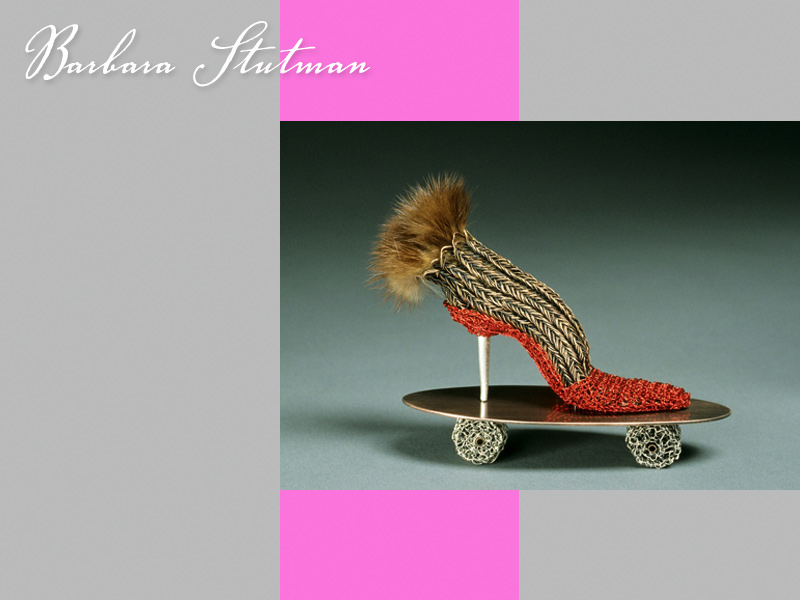
Being the candid female narrative jewellery advocate that she is, Stutman tries to liberate the female concept from traditional shackles and stereotypical metaphors which have been placed on females even by the media. In order to provide reference, this report will only include one of her works from the five part series.
Stutman, B.1999. Survival of the Footest 1. [ONLINE]

In the series “Impaired Visions”, she uses her craft to mock how the female is portrayed by media and shows how they try to create these unattainable fantasies which work on women’s insecurities in order to increase sales. She explains how these false ideologies are both damaging to a woman and limit her to conform (Stutman, 1997).


b. Negotiating Identity Series 


Figure 2, is from the four part series entitled, “Negotiating Identity”.  It is a three set made from fine silver, copper, nickel silver and polyurethane. In this series, she uses her work as a vehicle to narrate the negative ways in which mass media distorts women through ongoing processes. She once again uses her jewellery to show how women can be influenced to become whatever the media tries to paint them to become.

Figure 2 Stutman, B. (1996) How to Become a Woman Parts 1-3 Brooches. [ONLINE]

The piece set is entitled “How to Become a Woman, Parts 1-3”.  She is in a way mocking how the identity of the woman has been formed both traditionally and by media. In order to guide her audience she has relied not just on the imagery, but the titles of both the series and the pieces as an aid.

Saturday, 12 October 2019

Conclusion

Chapter Two of the report was a collection of relevant artist which could influence and inform my Chapter 3 report. One of these artists and jewellery designers was Stutman. Her background in fine art has greatly influenced her interpretation of what contemporary narrative jewellery is, as she creates jewellery that has sculptural forms to them, yet using her jewellery skills in order to provoke her audience. What I most associated with in her work was her ability to use imagery to create jewellery which addressed female issues, while at the same time working with relevance techniques, materials and colour choice. 
Byrne, like Stutman also manages to draw out her artistic background and portrays it in her work through the use of found materials, concepts and challenging the notion of how jewellery can be worn. 
My other example is also an artist; however Erismann is a poet who like Byrne uses her craft to create both dialogue and engagement with their audience of choice. I can relate with these three artistic souls as narrative and pushing conventional methods in order to express ones self and expand as a creative is an important part to their work.
This chapter also included a section where traditional Xhosa beadwork was discussed, this was to help inform ,y own creation as it displayed some f the imagery which was relevant for umakoti.

Barbara Stutman

Stutman is a contemporary female artist and jewellery designer who uses her work to comment on female issues mainly using symbolism[1] and irony within her jewellery work; which are an extension of her sculptures and paintings. 


This report has used Stutman as one of the contemporary examples as her work exhibits narrative characteristic’s which are similar to what this paper will be addressing. Therefore in Chapter Two, the report will provide a brief introduction and background on Stuntman’s work; while also discussing her work in the sequence below. 
  1. Which Issues does she address in her work?
  2. How does she deal with them?
                                 i.            Which materials has she used and why?
                               ii.            Which Techniques has she used?
                              iii.            What kind of Imagery andsymbolism has she used?
  1. How is her work similar to mine?

Thursday, 19 September 2019

What kind of Imagery and symbolism has she used?

As previously stated, the main focus of Stuntman's narrative works are women and she therefore relies on a lot of imagery which will depict the various aspects of created womenhood in order to express her narrative. 

Figure 26 Figure 27 Barbara Stutman, (1996) Stacking Reality Brooch. [ONLINE]

In her series entitled "Stacking Realities",  as seen above; she has created a womanlike figurine with a tray attached to her. 


Figure 28 Stutman, B (1993). One Being Female. Brooch [ONLINE]

Her work is a creative collection which uses a vast number of imageries all centred on that specific subject matter. An example of this is the 4 part brooch taken from her "One Being Female" series. With these Brooches, she has incorporated the use of tampons alongside fine silver, Spandex, colouredcopper wire, brass and copper. 


Figure 29 Stutman, B. (1998) It’s a girl! 2 Fine silver and coloured copper ring. [ONLINE]

She sometimes also used shoes, specifically high hills in order to mock media for their false idea of their ideal women.

As seen in the three examples provided, she has relied on the usage of various imagery based on the specific subject matter, but all pertaining to  women. 


Which Techniques has she used?


In her work, Stuntman predominantly ues techniques such as embroidery, weaving, crocheting and knitting, techniques which were traditionally used by women. She uses these specific techniques as juxtaposition tools in order express her views on women to the world.  

Figure 27, is an example of her work taken from the “Impaired Vision” series.

 Figure 27 Stutman, B. (1997) Sugar and Spice: Must we be Nice? Brooch. [ONLINE][1]

In this piece she has chosen to use both knitting and crocheting as her main techniques. With this series, she was attempting to depict how media does not give a true portrayal of women, but however uses devices in order to create insecurities within women in order to further thier own agendas. 

According to Rachel Felder, one of the authors of the online publication Good Housekeeping; red lipstick is "unique combination of boldness, strength, and self-assured sexiness". However these are all ideologies which have been placed into the human psyche through media through out history. 

She has skillfully used these techniques closely associated with women to almost ask "is this really what you want women to focus on?" With the aid of her material selection she was able to further emphasis judgement of media for their depiction of the women. 

Which materials has she used and why?


Figure 26 Barbara Stutman, (2015) Imperfect Beauty IB23 Neckpiece. [ONLINE] 
            
The above picture is taken from Stuntman's series entitled “Imperfect Beauty”, in this particular series she was trying to explore the beauty found in “the old, the blemished, the humble and irregular.” In order to create these pieces she has worked with stretch bead cord, coloured copper wire, freshwater pearls, seed beads and magnets.

She has chosen to use these materials in order to express her narrative as these materials are able to create a rough appearance and give the idea of something scrappy looking in comparison to what could be described as a beautifully polished finish. These materials also provide her with dimension without adding additional weight to the piece (Guyomarc'h, 2018).  

In her work, she predominantly places focus on her message and therefore tries to consider all the relevant factors which will influence the final delivery. Material is therefore ine of these important factors as displayed in the example above.b

How does she deal with them?


Figure 25 Stutman, B. (1996) How to Become a Woman Parts 1-3 Brooches. [ONLINE]

The picture above, is from the four part series entitled, “Negotiating Identity”.  It is a three set made from fine silver, copper, nickel silver and polyurethane. In this series, she uses her work as a vehicle to narrate the negative ways in which mass media distorts women through ongoing processes. She once again uses her jewellery to show how women can be influenced to become whatever the media tries to paint them to become.

The piece is entitled “How to Become a Woman, Parts 1-3”.  She is in a way mocking how the identity of the woman has been formed both traditionally and by media. In order to guide her audience she has relied not just on the imagery, but the titles of both the series and the pieces as an aid.


Which Issues does she address in her work?


Stutman tries to use her body of work as a vehicle which transports feminine concerns which are either swept under carpet and are not given a nondiscriminatory platform for conversation or consideration. Some of these concerns relating to the female gender that she deals with in her work are about incest, rape and even something as superficial as plastic surgery.
  1. Impaired visions series
Being the candid female narrative jewellery advocate that she is, Stutman tries to liberate the female concept from traditional shackles and stereotypical metaphors which have been placed on females even by the media. In order to provide reference, this report will only include one of her works from the five part series.
Stutman, B.1999. Survival of the Footest 1. [ONLINE] [1]

In the series “Impaired Visions”, she uses her craft to mock how the female is portrayed by media and shows how they try to create these unattainable fantasies which work on women’s insecurities in order to increase sales. She explains how these false ideologies are both damaging to a woman and limit her to conform (Stutman, 1997).