Showing posts with label narrative. Show all posts

Saturday, 12 October 2019

Emily Christiana Bryne

I have chosen Emily as one of my designers of choice because she has an interesting approach to her subject matters, which she addresses through the use of narrative jewellery. The main contextual basis for her work is the notion of what may be considered as jewellery and what jewellery is concerning the body.

Listed below are the guiding questions which I will be discussing her work under.
  1. Which Issues does she address in her work?
  2. How does she deal with them?
                                 i.      Which materials has she used and why?
                               ii.       Which Techniques has she used?
                              iii.      What kind of Imagery and symbolism has she used?
  1. How is her work similar to mine?


Thursday, 19 September 2019

What kind of Imagery and symbolism has she used?

As previously stated, the main focus of Stuntman's narrative works are women and she therefore relies on a lot of imagery which will depict the various aspects of created womenhood in order to express her narrative. 

Figure 26 Figure 27 Barbara Stutman, (1996) Stacking Reality Brooch. [ONLINE]

In her series entitled "Stacking Realities",  as seen above; she has created a womanlike figurine with a tray attached to her. 


Figure 28 Stutman, B (1993). One Being Female. Brooch [ONLINE]

Her work is a creative collection which uses a vast number of imageries all centred on that specific subject matter. An example of this is the 4 part brooch taken from her "One Being Female" series. With these Brooches, she has incorporated the use of tampons alongside fine silver, Spandex, colouredcopper wire, brass and copper. 


Figure 29 Stutman, B. (1998) It’s a girl! 2 Fine silver and coloured copper ring. [ONLINE]

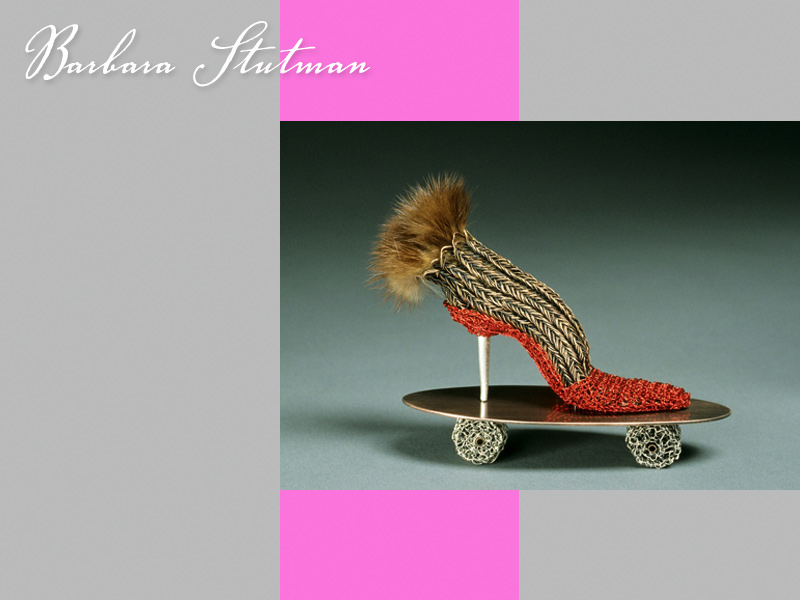
She sometimes also used shoes, specifically high hills in order to mock media for their false idea of their ideal women.

As seen in the three examples provided, she has relied on the usage of various imagery based on the specific subject matter, but all pertaining to  women. 


Which Techniques has she used?


In her work, Stuntman predominantly ues techniques such as embroidery, weaving, crocheting and knitting, techniques which were traditionally used by women. She uses these specific techniques as juxtaposition tools in order express her views on women to the world.  

Figure 27, is an example of her work taken from the “Impaired Vision” series.

 Figure 27 Stutman, B. (1997) Sugar and Spice: Must we be Nice? Brooch. [ONLINE][1]

In this piece she has chosen to use both knitting and crocheting as her main techniques. With this series, she was attempting to depict how media does not give a true portrayal of women, but however uses devices in order to create insecurities within women in order to further thier own agendas. 

According to Rachel Felder, one of the authors of the online publication Good Housekeeping; red lipstick is "unique combination of boldness, strength, and self-assured sexiness". However these are all ideologies which have been placed into the human psyche through media through out history. 

She has skillfully used these techniques closely associated with women to almost ask "is this really what you want women to focus on?" With the aid of her material selection she was able to further emphasis judgement of media for their depiction of the women. 

How does she deal with them?


Figure 25 Stutman, B. (1996) How to Become a Woman Parts 1-3 Brooches. [ONLINE]

The picture above, is from the four part series entitled, “Negotiating Identity”.  It is a three set made from fine silver, copper, nickel silver and polyurethane. In this series, she uses her work as a vehicle to narrate the negative ways in which mass media distorts women through ongoing processes. She once again uses her jewellery to show how women can be influenced to become whatever the media tries to paint them to become.

The piece is entitled “How to Become a Woman, Parts 1-3”.  She is in a way mocking how the identity of the woman has been formed both traditionally and by media. In order to guide her audience she has relied not just on the imagery, but the titles of both the series and the pieces as an aid.


Which Issues does she address in her work?


Stutman tries to use her body of work as a vehicle which transports feminine concerns which are either swept under carpet and are not given a nondiscriminatory platform for conversation or consideration. Some of these concerns relating to the female gender that she deals with in her work are about incest, rape and even something as superficial as plastic surgery.
  1. Impaired visions series
Being the candid female narrative jewellery advocate that she is, Stutman tries to liberate the female concept from traditional shackles and stereotypical metaphors which have been placed on females even by the media. In order to provide reference, this report will only include one of her works from the five part series.
Stutman, B.1999. Survival of the Footest 1. [ONLINE] [1]

In the series “Impaired Visions”, she uses her craft to mock how the female is portrayed by media and shows how they try to create these unattainable fantasies which work on women’s insecurities in order to increase sales. She explains how these false ideologies are both damaging to a woman and limit her to conform (Stutman, 1997).


Wednesday, 18 September 2019

Umakoti/ bride


Figure 18: Ndongeni, S. (2015) Umakoti clothing.

In many other Nguni groups, dress and accessories carried a narrative or visual symbolism for the wearer; though several of these have been lost due to modernization of the world. Nonetheless symbolism of dress and accessories still play an important role within the Xhosa culture especially when it comes to a marriage and being umakoti.

One of these is the headdress which is a symbol of respect towards both elders within the marital home and one’s husband (CSIR, 2018). Within each division of the tribes, various colours, clothing and beads hold various significances and when designing my final collection this will play vital role in the formation of my pieces (Magubane, vanishing cultures of south africa, 1998).

Ukuthwala-(bridal abduction)


Figure 1 James, A. Bachelors stage a kidnapping.  [ONLINE]
The bridal practice of ukuthwala (bridal abduction), has formed part of many South African native cultural groups, and has still remained as a cultural marriage practice in several places within the Eastern Cape (Froko, S. M. 2016). As the Eastern Cape is predominately a Xhosa populated part of the country, the report will be exploring this practice through the Xhosa culture. There are not many positives when it comes to the practice of bridal kidnapping, therefore this report will instead introduce the historical justification for the practice.
  1. Historical bases

It is believed that the practice of ukuthwala in South Africa originated with the Xhosa people (Mwambene & Sloth-nielsen, 2011). Initially the practice came about in cases when either the girl’s family or both families, would be against a marriage or would not come into agreement with labola, and then the couple would stage this abduction, in order to force their  families to allow the marriage to take place.
Although not inherently a form of an abusive abduction, it has mutated into a form of marriage which results in abuse, violence and in many unfortunate cases resulted in rape. Traditionally the practice may be conducted in one of two ways; there are cases where the girl’s family has consented to the marriage and the abduction of their daughter. In this case, the two families have met without consulting the girl in question and have even concluded with the lobola negotiations in most of these cases. Then the two families for whatever the reasons may  be agreed to a specific date on which this abduction would take place (Modisaotsile, 2013).


  1. Negatives
In a paper written by Nomusa Mphanga (Maphanga, 2011), one of the drawbacks of the custom of ukuthwala was that men soon abducted the young girls as a result of a spiteful kind of love. The aim was no longer to preserve a custom, nor was it a sign of respect for either the young woman nor their families, it was all about breaking her virginity in order to force the family to permit the marriage.

The sad reality of our society is that a woman is judged more harshly than a man; to the extent that even in cases when she has been violated she is forced to either hide what has taken place or bare the stone of society. Until the recent events which have transpired in our country, it was easy to get away with rape. However now, women have had enough and have learned to voice out their frustration, nonetheless this was not always the case.

When the custom of ukuthwala began to become distorted, it forced the woman, the young girl to not just suffer the pain of rape, but to be sentenced to a life with her rapist all in the name of persevering the dignity he had stripped away from her (Maphanga, 2011; South African Abductions: young girls forced into marriage, n.d.).

The practice of ukuthwala has now become an illegal practice within South Africa and many countries throughout the world. There were cases where the man’s family are in agreement and have not met with either the young girl nor her family and simply decide to ambush her at their earliest convenience, to then inform the girl’s family once they have kidnapped her of what they have done.
 No matter what the circumstance is, when the girl is unaware of this sort of marriage, it may be traumatic for her, as she is taken against her will and then forced to become a wife to someone she may not even know, and at times a man who is 15 to 40 years her senior.

Common elements between narrative jewellery and poetry

Based on the various information I have provided above, I have found several common factors that exist between poetry and narrative jewellery which will aid me in my work. I have found that the key principles to any narrative are the imagery, symbolism, technical execution and the ability to use the craft to inform of a specific subject matter. The importance of this is that when creating my narrative either in poetry or jewellery, these will help direct my work.

Friday, 9 August 2019

Barbara Stutman

Stutman is a contemporary female artist and jewellery designer who uses her work in order to comment on female issues using chiefly symbolism[1] and irony within her work.  Having a background in fine art, she has used her jewellery as an extension from what she had with her sculptures and paintings.
This report has used Stutman as one of the contemporary examples as her work exhibits narrative characteristic’s which are similar to what this paper will be addressing. Therefore in Chapter Two, the report will provide a brief introduction and background on Stuntman’s work; while also discussing her work in the sequence below. 
  1. Which Issues does she address in her work?
  2. How does she deal with them?
                                 i.            Which materials has she usedand why?
                               ii.            Which Techniques has she used?
                              iii.            What kind of Imagery andsymbolism has she used?
  1. How is her work similar to mine?


[1] “is an object or thing that has meaning more than the thing itself . A dog might represent fidelity in addition to being a pet; it is a visual sign for an idea or concept.” (Anon)
For the purposes of the paper, when the word symbol or symbolism is discussed, it will be referring to a representation any object, thing, person, feeling, living or any other non-living organism which is the specified subject matter.


Thursday, 8 August 2019

ILobola/ bride price

The practice of paying lobola or dowry is one which is regarded as an integral part of many African marriages; it is, in fact, a practice which is not limited or exclusive to African cultures but is part of other cultures in the world such as the Indian culture and the Jewish people, who refer to it as dowry  (Gullapalli, 2009) (Liebenberg,n.d.).
 
Figure 1 Tina, T. (2018) Three uncles negotiating lobola. [ONLINE] [1]
  1. Positives
The importance of the payment of the bridal price is seen as an act of respect for the bride and her family; as it is seen as a gesture of gratitude while also displaying his fidelity and commitment to his bride and also displaying good care of her by proving that he values her. Contrary to many false beliefs, the bride price is not a payment of the daughter nor is it the purchase of a bride, it is, however, a gesture which displayed the man would be capable of providing for the bride and that he and his family were people of substance (Magubane, 2001). Also, it was a security bond posted by or on behalf of the bridegroom as a pledge of good treatment; a man was not likely to abandon such a substantial investment, and in most societies, if a divorce resulted because of abuse and ill-treatment, all or most of the lobola was forfeited.
 
Since lobola is a gesture most families do not require the full payment to be made before marriage as it is believed that since no true price can be placed on their priceless daughter. A man can never fully pay lobola but is however responsible to make payments (for a lack of word) to the family for life. These payments come in the form of making sure that the needs and wants of the bride’s family are taken care of when they arise, these thus count as the bottomless lobola price the husband is to pay for the daughter he has taken as a wife (Ngema, 2013).


Although meant to be a gesture of gratitude and a symbol that the daughter will be well taken care of; like many things within society this practice has been abused and the process has been polluted by many people to satisfy their own personal desires and interests. These have been done through the demand of a bridal price which is beyond the means of what the man can afford, or in some cases families may require the man to pay an amount which is too high as the family considers their own personal needs and wants.

In other instances, the process becomes tainted as the daughter becomes a bargaining chip or even an object to be sold to the highest bidder and her family disregards what is in the best interest of their daughter to make money off her marriage. An example of such cases would be the process or the marriage which is the result of ukuthwala (bridal abduction).
Another way the best interest of the bride does not play a key factor is when the family forces her to marry for money or status rather than to marry for love. This type of marriage is then regarded as forced marriage, rather than arranged marriage.

The payment of lobola has been one of the many factors within the African native cultures which has aided in the difficulty of divorce. With a process so flawed and ungoverned by neither law nor many restrictions besides what families decide is just and fair payment, should such a practice be found to be relevant in this contemporary and liberal world we live in? It actually should still be practiced as there are several consequences that are directly linked to the refusal to partake in the practice. One of these being that the couple may not be fully received by both families if they do not choose to adhere or observe important cultural practices. The wife may be ostracized by other family members of the husband’s family and may not be considered a true makoti within the family.

Child marriage

Child marriage was and still is another marriage form within the Xhosa culture which brings about much concern. In the past and in many rural places with South Africa and the world, the girls who enter such marriages may be even as young as eight years old or even nine years old (Silva-de-Alwis, 2008). This in terms is an issue as there many disadvantages which are associated with child marriages such as miscarriages.


This marriage type caught my attention as throughout history and the modern day, large numbers of young girls are forced into entering such marriages. Regardless of child laws and children’s rights which are I place, however millions of girls still fall through the cracks and in many cases it is their own parents who push them through the cracks. (Anon., 2018) (South African Abductions: young girls forced into marriage, n.d.)

 To further tie this issue to the report is the fact that in some cases these young girls entered these marriages as a result of abduction.  Hence when the report addresses child marriages, it is referring to any marriage which has occurred involving persons or a person under the age of 18.

Figure 1 Human rights brief. #ChildNotBride protest. [ONLINE][1]


Umakoti/ bride

 I have found that there are rules to be followed and even a specific hierarchy even among the brides within the family, which is determined by many factors one of these being how long one has been married; thus giving umakoti that has been married longer superiority over a recently married umakoti., this is regardless of the wife’s age.

As part of being umakoti, you are in some ways treated as a new born, in the sense that when you become a new member of the family and are welcomed into the family, you are given a new name and brand new clothes. As you are no longer a girl but a wife, you are then given instructions by the family on how to conduct yourself within the family and depending how strict the family is, you are given instructions on how to conduct yourself outside the family, this is called ukuyala. 

Once this process has been conducted, according to tradition, you are to no longer to be referred to as your birth name, but you may however be called your clan name, and the new wife is to no longer refer to her husband by name especially in front of others, she is to call him bhuti or Tata ka so-and-so (so and so father, the name of the their first born child).  He on the other hand may call you by name; however the name his family has given you. There is so much more involved in the making of umakoti, however for purposes of this report, when I refer to umakoti unless stated, I am referring to someone who has been married for 15 years or less, as a wife who is married longer is regarded as umfazi. 

Poetry as a Narrative

All poetry is narrative as each word or line expresses a message. As defined in the beginning section of Narratives poetry, poetry uses language to express its chosen perspective of reality. Using poetry devices such as metaphor, rhyme meter, etc; the poet can transfer thought, feeling, and experience.
Traditional poems focused attention to rhyme structure, rhythm, and other poetry devices, while the more modern narrative poems tend to break those traditional rules and may even have no specific rhyme within the poem itself. However, one common reality that remains though is that it tells a story, it provides brief or intense descriptions concerning the subject matter and is ultimately more dramatized, unlike the other poetry classifications.
This report has therefor defined poetry any given emotion, thought or situation. As a painter would use their colour and art principles in order to create  a specific feeling or portrayal of a subject in order to engage with an audience, so does a poet with words. However, they would use poetic principles in order to achieve this.


Poetry

Before I discuss narrative poetry, I felt that it would be best to give my brief interpretation of what poetry is. One definition
 “A composition that conveys experiences, thoughts or feelings in a vivid and imaginative way. It is characterized by the use of literary techniques such as metaphor, rhyme or meter. “
There are various classifications find in poetry, mainly:
Narrative
Lyrical
Limerick
Free verse
Haiku
Concrete
Dramatic
Keeping the above given information, I would define poetry as an intentional arrangement of works so as depict any given emotion, thought or situation. As a painter would use their colour and art principles in order to create  a specific feeling or portrayal of a subject in order to engage with an audience, so does a poet with words. However they would use poetic principles in order to achieve this

Xhosa keepers


Figure Xhosa woman wearing a Keeper. (ONLINE)
Figure 1  Xhosa woman wearing a Keeper. (ONLINE)[1]


Figure Xhosa woman wearing a Keeper. (ONLINE)

The woman in the picture above is wearing a Xhosa traditional Keeper which depicts the stage she is now in as a Xhosa wife. The triangles symbolize an older married woman, and the fact that the woman in the Keep has no legs is an indication that the woman wearing the keeper feels that she is worn out at this stage in her life and she, therefore, will not have any use for her legs. 


Narrative Jewellery

One of the most prominent jewellers when it comes to contemporary narrative jewellery is Professor Jack Cunningham. In addition to being a contemporary studio jeweller, he is a curator and an academic, who has made a huge contribution to the field. The picture below is part of a series by Cunningham entitled: “The Great Barrier” (Commentaire, 2013)

Figure 1 –Withycombe, D. (2010)The Great Barrier Brooch. [ONLINE}[1]

In order to depict his personal narrative, Cunningham, has chosen to use found objects. This work has been used to illustrate what narrative jewellery is, as is has been manufactured using found objects and has relied on its title to help indicate its narrative to its viewer.
According to Cunningham narrative jewellery may be described as:
 “…small objects that have the potential to speak of large issues make bold statements and question accepted values.”

When observing his piece alongside his definition, a connection may be established. Hence this report has accepted this definition as it will be using jewellery a means to address bridal umakoti issues which are prevalent within the Xhosa lives of many young girls and women.

Within the category of narrative jewellery, this report will be looking at the following types of narrative works:

                                   a.            Narrative jewellery
                         b.       Xhosa Beadwork as a narrative   


Narrative

For the purposes of this report, narrative works may be explained as translating reality into a form in which the intended target may comprehend the idea or angle the artist is illustrating or addressing with their craft. This is confirmed in the quote below written by Hazel Paul, taken from her report 
based on narrative works.

“A narrative is re-presentation of reality from a particular perspective: reality reconfigured to express meaning”  (Hazel, n.d.).

Figure 1 Andrea Previtali, Italian, ca. 1470 – 1528, The Annunciation, ca. 1520-1525, Tempera on wood panel, Gift of the Samuel H.
Kress Foundation 61.197. (ONLINE)[1]
The above picture is a narrative art work done by Andrea Previtali, it depicts the annunciation[2] of Mary, which is an important event within the Catholic Church, as it depicts the moment when the angel Gabriel was informing Mary that she would be the mother of Christ. Referencing from the narrative definition given by Paul, one would be able to observe the choice of symbols used within the work of art so as to express the painter’s narrative. The artist Previtali has given Mary and the angel halos, which is a symbol used within the Catholic circles to depict a saint. The other symbolism, which has been included is the dove, which was present at the Baptism of Jesus, this could be the painter’s way of expressing the authoritativeness of the message, as one ascending from God Himself.
 When it comes to analyzing a narrative work regardless of the art discipline, there are certain key aspects which the artist needs to keep in mind; however in the section below I will be discussing these as it pertain the relevant field of this report.
 There are many forms in which a narrative may be depicted; however this report will mainly be focusing on three forms of Narrative forms these being 
 Narrative jewellery and Poetry (Rabinowitz, J. 2005).

Friday, 26 July 2019

The rope version

Figure 1: Ndongeni, S (2018). Suicide by Rope neckpiece.
For this version of the series, I had made several neckpieces which as stated were created from actual rope, which were then tried as a noose to be worn around the neck.

Figure 2: Ndongeni, S (2018). Suicide by Rope neckpiece.

In order to tie the poetry and the actual pieces, I had decided to use flowery image once again, as it would depict this young flower (a girl), which never got to bloom into the woman she was meant to become.
Figure3: Ndongeni, S. Suicide by rope type 2. 

In figure 2, I had decided to use red beads when making some of the items as these would also indicate the poured out blood.


Figure 4: Ndongeni, S. Suicide by rope type 3. 

The small purple figurines in figure 3 and 4 are meant to be representative of girls who were kidnapped or forced into marriage before turning 18 years, which is why I chose to use 18 headless figurines.  This concept is similar to that of Stutman, who had used crocheted female figurines to represent women. I also found that it would help create an irony of sorts, as Xhosa dolls/ figurines are usually given to females as charms rather than a representation of their death. 
Figure 5:: Ndongeni, S. Suicide by rope type 3, beaded elements.

Monday, 22 July 2019

The Evolution of a Queen

In an earlier post I had written, I had posted about an item of jewellery worn by a Game of Thrones character (see link https://jewellersbride.blogspot.com/2019/06/daenerys-targaryen.html?m=1)
I came across this video which gives a brief flash of how this character once exchanged by her brother for personal gain, decided she would not be defeated by the life circumstances of her marriage, but instead rose to be a loved Queen.

I guess this is an example of when a person refuses to allow life to defeat them.