Showing posts with label Xhosa beadwork from from East London Museum. Show all posts

Tuesday, 15 October 2019

Xhosa Fertility Charms

Figure 1: Ndongeni, S (2019). Xhosa Fetility Charms. 
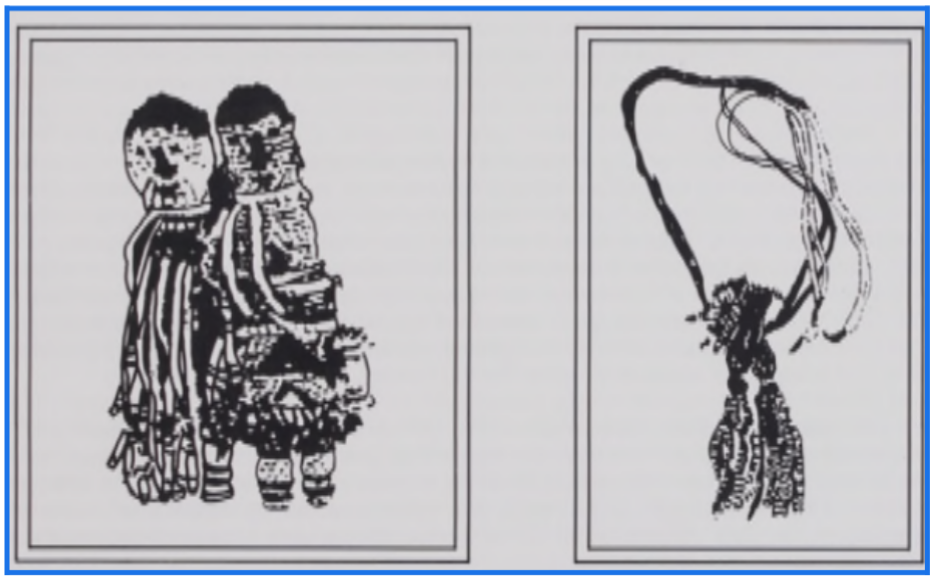
According to Nandipha (Nandipha, 2019), an anthropologist at the East London Museum, it was a common practice amongst the Bantu speaking people to present a bride a doll as it was believed that it would aid her with child bearing. The bride was to then keep this doll with her at all times until the point when she was able to conceive. The picture below is an example of traditional dolls work by married women.
Figure 2: Ndongeni, S (2019). Xhosa Fertility Charms Display, East London Museum.

While at the museum, I had found that there was a lot of symbolic imagery used within the traditional Xhosa beadworks. I will however be only discussing those which are relevant this research report. 

Figure 3: Ndongeni, S. (2019). Xhosa love dolls , East London Museum.

The Xhosa love dolls in figures 1 to 3 were traditional worn by young girls who had the "misfortune" of not receiving a marriage proposal. These were not made by the young woman themselves, but were however made by old woman and were then to be secretly worn around the neck, until such a time the young girl received a marriage proposal.

These dolls were believed to have the ability to attract a husband.These dolls would therefore fall under the classification of spiritual jewellery. 

Saturday, 12 October 2019

Xhosa beadwork from East London Museum

During my time at home in East London, I had visited the East London museum to get some information about the Xhosa people. I had an interesting conversation with one of the anthropologists from the museum, who gave me a lot of historical facts concerning the Xhosa people especially their beadwork. 
Ndongeni, S. (2019). Xhosa beadwork Exhibition. 
 The display in figure 1 forms part of several displays that are dedicated to exhibiting Xhosa beadwork. I have also included a closeup picture of the painting which was placed above the display as it shows drawings of Xhosa people wearing their jewellery.
 

As I will be using Xhosa bridal narrative as one of the bases for my chapter 3, it is important to understand some of the relevant Xhosa beadworks in terms of how they have used it in order to express their various narratives.
I will be discussing these under the headings listed below. 
b.       How do they deal with them?
                                 i.      Which materials have they used and why?
                                  ii.            Which Techniques have they used?
                                iii.            What kind of Imagery and symbolism have theyused?
c.       How is their work similar to mine?

Friday, 4 October 2019

Which Issues are they addressing in their beadwork?

Due to the length of the research, this report will be discussing two of the main uses of Xhosa beadwork. 

Health 

Charms
According to Nandipha (Nandipha, 2019), an anthropologist at the East London Museum, it was a common practice amongst the Bantu speaking people to present a bride a doll as it was believed that it would aid her with child bearing. The bride was to then keep this doll with her at all times until the point when she was able to conceive. The picture below is an example of traditional dolls work by married women.
Figure 33 Costello, 1990, Traditional Xhosa dolls


Which materials have they used and why?


As previously mentioned in Chapter One, the Xhosa people are a spiritual people whose beliefs impact every spectrum of their lives. It is therefore no surprise to discover that their choice in beading materials is also influenced by their beliefs. 

A vast number of their beadwork include various types of charms ranging from the conception of a child, marital issues to mention a few. The above picture is one of the displays which was exhibited in order to show the various charms which held not just meaning for the Xhosa people, but held spiritual powers. 


One of the pieces from the display was a necklace made from lucky beans which comes from the erythrina caffra tree. According to Xhosa beliefs, this tree was believed to symbolise "health, prosperity and a good season."  Therefore if one hoped to attract these into their lives, they would then have to wear a piece of jewellery, as in this case a necklace strung with such seeds. 

What kind of Imagery and symbolism have they used?

Ndongeni, S (2019). Xhosa Fertility Charms Display, East London Museum.b
While at the museum, I had found that there was a lot of symbolic imagery used within the traditional Xhosa beadworks. I will however be only discussing those which are relevant this research report. 

Ndongeni, S. (2019). Xhosa love dolls , East London Museum. 
The Xhosa love dolls in the picture above were traditional worn by young girls who had the "misfortune" of not receiving a marriage proposal. These were not made by the young woman themselves, but were however made by old woman and were then to be secretly worn around the neck, until such a time the young girl received a marriage proposal.

These dolls were believed to have the ability to attract a husband.These dolls would therefore fall under the classification of spiritual jewellery.